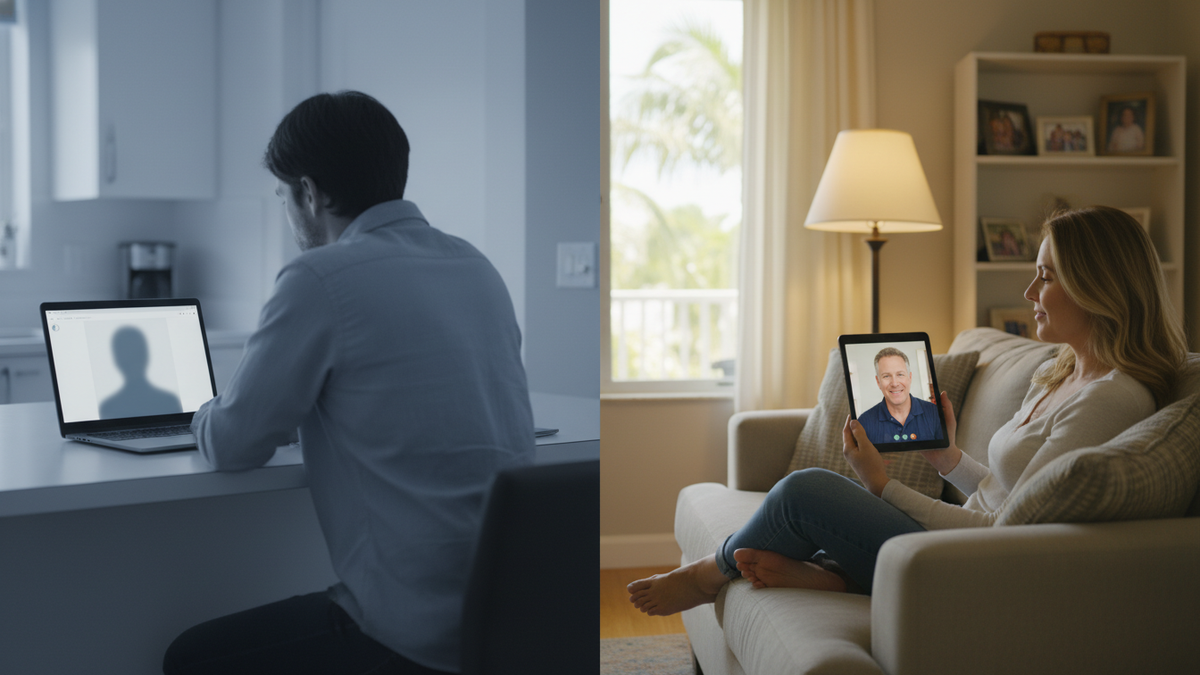
Telehealth has changed healthcare for the better in real ways. Being able to see a physician from your home, without commuting or waiting rooms, is genuinely useful. For patients in rural areas, patients with limited mobility, or patients with straightforward acute issues, it works.
But telehealth apps and concierge medicine get conflated in a way that causes patients to make the wrong choice. Both involve remote access to a physician. Both are convenient. That's roughly where the similarity ends. Choosing the wrong option can leave you with the illusion of quality care while the same gaps in your health go unaddressed year after year.
TL;DR
- Telehealth apps (Teladoc, MDLive, etc.) = transactional, episodic, ~$75-150/visit, see whoever's on shift, good for one-off acute issues
- Concierge medicine = relational, longitudinal, includes telehealth + same-day visits + house calls + proactive monitoring, with a physician who knows you
- Telehealth catches the symptom you came in with; concierge catches the trends you didn't know to ask about
- For chronic conditions, complex history, or anything beyond an acute one-off, the relational model is the one that prevents bad outcomes
- To reach the practice: call or text 561-468-6981
What telehealth apps actually offer
Platforms like Teladoc, MDLive, ZocDoc, and similar services provide rapid access to a physician, nurse practitioner, or physician assistant (usually within hours) for acute, episodic concerns. Sore throat, UTI, sinus infection, a prescription refill. You log on, see someone for 10 to 15 minutes, get what you need, and move on.
What telehealth does well:
- Speed for acute issues. Same-day access for time-sensitive, straightforward problems.
- Geographic reach. Getting seen when you're traveling or in an area without convenient care.
- Prescription convenience. Refills and standard antibiotics without an in-person visit.
- Low cost for episodic care. Typically $75 to $150 per visit, often covered by insurance.
The underlying model is transactional. You have a problem, a stranger helps you solve it, the relationship ends when the visit does.
Where telehealth apps systematically fall short
The limitations aren't design flaws. They're structural consequences of the model.
No longitudinal relationship. The provider you see today has no history with you. They're working from what you tell them in the first five minutes and whatever's visible in the system's records. No one knows your patterns. No one remembers your previous labs, your response to prior medications, or the things you tend to minimize when describing symptoms.
No accountability. With multiple telehealth visits across different providers, no one owns the outcome. There's no single physician tracking you longitudinally, noticing patterns, and following up to make sure things resolve.
Not suited for chronic or complex conditions. Hypertension, diabetes, thyroid disease, chronic anxiety, any condition that requires ongoing management. Telehealth apps can supplement primary care for these patients, but they can't replace it.
The "unknown unknown" problem. The most consequential health issues are the ones you don't know to ask about. A physician who knows your risk factors, family history, lifestyle, and previous labs can notice things a stranger can't. Blood pressure that's been creeping up over two years. A subtle pattern in your labs suggesting early metabolic dysfunction. A change in mood or sleep that warrants real attention. Telehealth apps don't catch those. Continuous relationships do.
What concierge medicine adds
Concierge medicine is telehealth plus the thing telehealth is missing.
In my practice, you get telehealth access; you can call, text, or video any hour for acute issues. Underneath that convenience layer is a continuous relationship with a physician who knows you comprehensively.
Longitudinal knowledge. I know your history, risk factors, prior diagnoses, what's worked and what hasn't. When something new comes up, it gets interpreted in the full context of your health story, not in isolation.
Proactive care. Rather than waiting for you to notice a problem, I track your metrics over time and flag concerns before they become crises. Annual comprehensive physicals with detailed labs, follow-through on results, and proactive outreach when something warrants attention.
Coordination. When you need a specialist, I handle the call, give the specialist context, and coordinate the follow-up. Care doesn't fall through the cracks between providers.
Time. Appointments aren't constrained to 15 minutes. Room for the real conversation, not the abbreviated version that fits a scheduling grid.
Direct access. My cell phone number, not a call center.
For more on what concierge medicine covers, see what is concierge medicine: a complete guide and concierge medicine without insurance.
When telehealth is the right tool
Telehealth apps make sense when:
- You need same-day access for an acute, straightforward issue
- You're traveling and need a prescription refill or quick evaluation
- You have established care elsewhere and need episodic supplemental access
- Cost is the primary constraint and your needs are simple
When concierge is the right tool
Concierge makes sense when:
- You have chronic conditions that require ongoing management
- You want proactive, preventive care rather than reactive sick visits
- You have a complex health history with multiple conditions or medications
- You've been rushed through appointments and want your concerns addressed fully
- You want a physician who's specifically accountable to you
The underlying distinction
The core difference is whether healthcare is transactional or relational. Transactional healthcare (which includes most telehealth apps) is efficient for discrete problems. Relational healthcare (which is what concierge medicine provides) is what catches the things that fall between the cracks, manages complexity over time, and keeps you ahead of problems rather than treating them after they show up.
Also worth reading: concierge medicine vs. urgent care and ER and telehealth as part of concierge care.
Frequently Asked Questions
Do you do video visits in your concierge practice?
Yes. A meaningful share of care in this practice happens by phone or video when an in-person visit isn't necessary. The difference from a telehealth app is that the video visit is with the physician who knows you, with full access to your history and labs, integrated into your ongoing care rather than treated as a one-off encounter.
What about Teladoc-style apps for me as a backup?
Useful as a backup when traveling internationally or in a situation where reaching your concierge physician isn't practical. Most concierge patients use telehealth apps occasionally for those edge cases. The point isn't that telehealth apps are bad; it's that they're the wrong choice as your primary medical relationship.
How do I know which model fits my situation?
Ask: would I benefit from a physician who knows me over time, who proactively tracks my health, who coordinates my specialists, who's reachable when something concerning happens? If yes, the relational (concierge) model fits. If your medical needs are genuinely simple and episodic, the transactional (telehealth) model can be sufficient.
Can I have both?
Yes, and many concierge patients do. The concierge relationship is the foundation; telehealth apps are an occasional supplement when your concierge physician isn't reachable (rare in this practice, but it happens during international travel or unusual schedules).
What about condition-specific apps like Hims, Maven, or weight-loss-only telehealth services?
These are even more transactional than general telehealth and even more limited in scope. They handle one specific condition without seeing the whole picture. Useful for narrow, defined needs. Risky if used as a primary medical relationship because they miss the comorbidities, interactions, and broader health context that competent primary care catches.
How to evaluate a concierge practice for real telehealth integration
Concierge practices vary widely in how they integrate telehealth. The best ones treat video and phone as core delivery modes, not afterthoughts. The criterion is panel size: below 300 patients makes both in-person and remote access genuinely available; above 600 doesn't, regardless of marketing. (Full criteria for evaluating any concierge practice.)
About the Author
Dr. Ben Soffer, DO is a board-certified physician practicing concierge primary care in Boca Raton, Florida. He keeps his practice intentionally small, which is what makes both real telehealth integration and real in-person care structurally possible.
If you've been bouncing between providers without continuity
A no-obligation conversation about whether this practice fits your situation.
- Call: 561-468-6981
- Email: info@drbensoffer.com
- Or reach out through the contact form