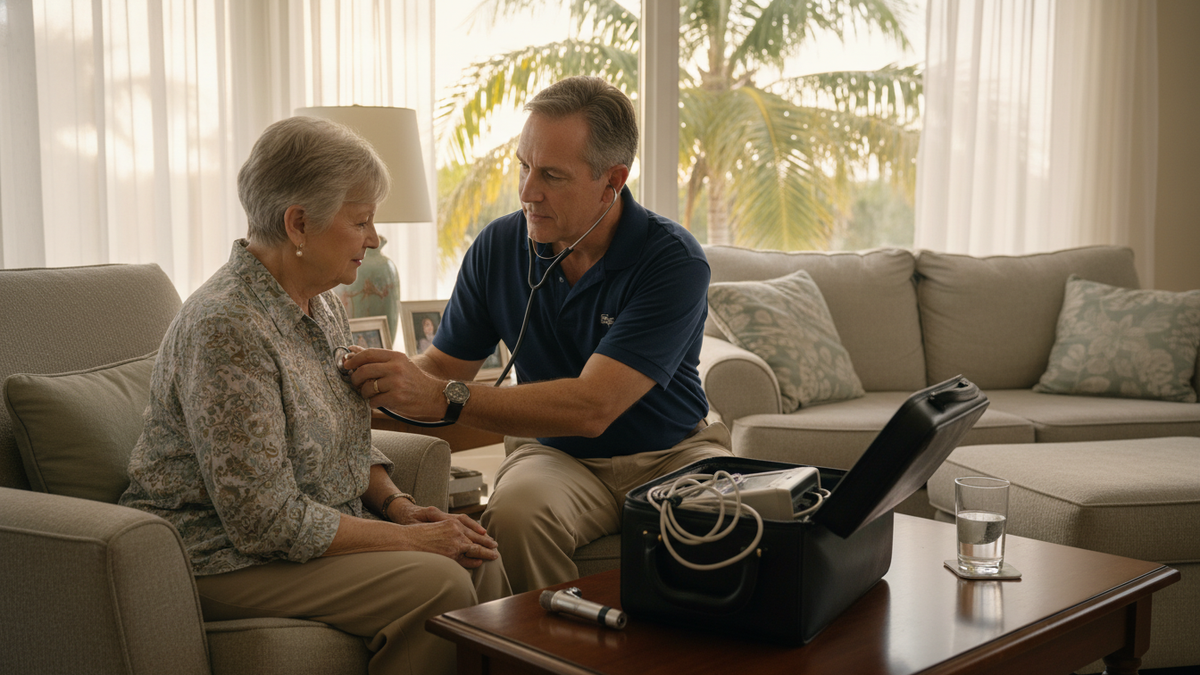
House calls were 40 percent of physician visits in 1940. By the 1980s they were below 1 percent. What happened in between is essentially the story of why traditional primary care is the way it is: insurance reimbursement favored the office, medical technology stopped being portable, and the volume math made it impossible for a physician to leave the building for a single patient. House calls didn't stop being useful. They stopped being billable at a rate that made them viable.
That's changed. A few things shifted at once: concierge and direct-pay models broke the reimbursement problem, diagnostic equipment got small and capable, and the patient population that benefits most from being seen at home (older adults aging in place, busy professionals, post-hospital recovery) got larger. House calls are back as a serious medical service, not a nostalgic gesture.
TL;DR
- In a Palm Beach County concierge practice, house calls are included in the membership, no per-visit charge
- Same-day or next-day visits across Boca Raton, Delray, Boynton, West Palm, and surrounding cities
- Full primary care at home: physical exam, point-of-care testing, mobile labs, prescription management, specialist coordination
- For real emergencies (chest pain, stroke symptoms, severe injury) call 911. House calls are not for emergencies.
- 24/7 direct cell access to the physician, not an answering service
Why house calls work in a concierge practice
The average American spends about 121 minutes on a doctor visit when you factor in travel, parking, waiting, and the appointment itself. Face time with the physician averages around 7 minutes. House calls reverse the math. The physician comes to you. No waiting room, no commute, no exposure to other sick patients. The visit itself is longer because there's no back-to-back schedule to maintain.
Under a traditional insurance reimbursement model, house calls don't work economically. Under a concierge membership model, they do, which is why they're coming back.
How house calls work in my practice
Direct contact
You reach me on my cell phone. Not an answering service, not a callback from a nurse.
Same-day or next-day visits
If a house call is appropriate, I come to your home, often the same day. I bring the equipment for a full physical exam: otoscope, ophthalmoscope, stethoscope, blood pressure cuff, pulse oximeter, portable EKG, and supplies for point-of-care testing. For more advanced imaging or testing (portable X-rays, comprehensive blood work, ultrasound), I coordinate mobile services that come to your home, usually the same day.
The visit covers primary care at home
- Physical examination and vitals
- Point-of-care testing when needed
- Blood draws for lab work (mobile phlebotomy)
- Prescription management
- Specialist referral coordination
Follow-up
I call you personally with results. Not a portal message. If something needs specialist evaluation or imaging, I coordinate it directly.
Why the house often beats the office
A few things shift when the visit happens at home instead of in a clinic.
You're not sick in a waiting room. When you're genuinely ill, driving across town and sitting with other sick patients is the last thing you need. You rest. I come.
I see the environment. Medication bottles on the counter. The way the stairs work. The actual diet in the fridge. How the bathroom is set up. That context matters enormously for clinical decisions, especially for older patients and anyone with a chronic condition.
Family can participate. Spouse, adult children, primary caregiver. Everyone involved in the patient's care is in the same conversation at the same time, which solves the classic handoff problem where one person heard one thing and another person heard something different.
Continuity is stronger. I know what your living room looks like. I know which neighbor helps with groceries. I know which medications are in which drawer. That sounds trivial. It isn't.
What a house call can handle
Essentially everything a primary care office visit handles:
- Acute illness: flu, strep, sinus infections, UTI, stomach bugs, minor infections
- Chronic disease management: diabetes, hypertension, thyroid conditions, cholesterol management
- Annual physicals: a full 60 to 90 minute evaluation at your kitchen table
- Post-surgical follow-up: wound checks, medication management, recovery monitoring
- Minor acute issues: allergic reactions, minor injuries, acute pain management
- Preventive care: vaccinations, screening coordination, wellness visits
For true emergencies (chest pain, stroke symptoms, serious injury, severe shortness of breath), call 911. House calls aren't meant for emergencies. If you're unsure what qualifies, call or text me and I'll help you decide.
When hospitalization is needed
Occasionally, a house call reveals something that requires hospitalization. When that happens, I'll go with you to the hospital, brief the admitting physicians directly, and ensure a smooth transition of care. I don't disappear when you enter the healthcare system.
The same applies after discharge. The first two weeks after a hospital stay are when most readmissions happen. A house call during that window catches the problems early: medication confusion, unresolved symptoms, missed follow-ups.
Where I make house calls
Throughout Palm Beach County, including:
- Boca Raton (home base)
- Delray Beach
- Boynton Beach
- Lake Worth
- Palm Beach
- West Palm Beach
- Highland Beach
- Gulf Stream
- Manalapan
- Lantana
- Wellington
- Deerfield Beach (northern Broward)
- Parkland (northern Broward)
Snowbirds and seasonal residents tend to find the model especially valuable for continuity across their Florida months.
What to have ready
A few things make the visit go smoother:
- A current list of medications (or just bring me to the cabinet where you keep them)
- Any recent test results or discharge paperwork
- A list of questions or concerns you want to cover
- A comfortable, well-lit area for the exam (kitchen table or living room works)
That's it. I handle the rest.
Cost
House calls are included in the concierge membership. There's no per-visit fee for me to come to you.
The membership covers:
- Same-day and next-day visits, at the office or at home
- Direct cell phone access (text or call, 24/7)
- Comprehensive annual physicals
- Care coordination with specialists and hospitals
My practice is private-pay; I don't bill insurance for the membership. You keep your existing insurance for everything that happens outside my office (labs, imaging, specialists, prescriptions, hospital care).
Who benefits most
- Older adults who find travel difficult
- Busy professionals who can't spend half a workday at a doctor's office
- Parents of young children who can't easily leave the house
- Post-surgical and post-hospitalization patients recovering at home
- Snowbirds who want medical continuity during their Florida months
- Anyone who doesn't want to sit in a waiting room with other sick patients
House call versus urgent care
| House call | Urgent care | |
|---|---|---|
| Wait time | None | 30 to 120 minutes |
| Doctor knows you | Yes | No |
| Visit length | 30 to 60 min | 7 to 10 min |
| Follow-up | Personal call | Portal message |
| Cost | Included in membership | Copay plus sometimes surprise charges |
| Hours | 24/7 | Limited |
Frequently Asked Questions
How long does a house call take?
Usually 30 to 60 minutes. For a new patient or a complex visit, closer to an hour. For a quick follow-up, less.
Can you treat emergencies at home?
No. House calls are for non-emergency acute issues and chronic care. For true emergencies (chest pain, stroke symptoms, serious injury, severe shortness of breath), call 911. If you're unsure what qualifies, call 561-468-6981 and I'll help you decide.
What if I need imaging or specialist care?
For imaging and advanced testing, I coordinate mobile services that come to the home. For specialist care, I handle the referral directly and stay in the loop on the handoff.
Are house calls more expensive than office visits?
In my practice, house calls are included in the concierge membership. No additional fee for me to come to you. You use your existing insurance normally for outside services (labs, imaging, specialists, prescriptions, hospital).
Do you do post-hospital follow-up visits?
Yes. These are some of the highest-value house calls I do. A visit in the first week after discharge catches medication mistakes, unresolved symptoms, and missed follow-ups that would otherwise send people back to the hospital.
Do you accept Medicare for house call services?
The concierge membership itself is private-pay and is not billed to Medicare. Medical services performed during house calls (E&M codes, labs, vaccines) can be billed to Medicare in the standard way for Medicare-participating physicians. Medigap and Medicare Advantage interact normally with the covered services.
About the Author
Dr. Ben Soffer, DO is a board-certified physician practicing concierge primary care in Boca Raton, Florida. He keeps his practice intentionally small, which is what makes house calls included in the membership rather than a per-visit luxury. He sees patients at home throughout Palm Beach County.
If you want to talk
If you're in Palm Beach County and want a physician who makes house calls, here's how to reach me:
- Call: 561-468-6981
- Email: info@drbensoffer.com
- Or reach out through the contact form